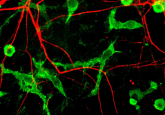
Tau inhibitor may block self-association and fibril formation in mice

A highly detailed 3D rendering of a double helix human DNA in blue color, with small carbon elements and light effects on a dark gray-blue background. The image shows an angle of view of different
Previous research has demonstrated that tau load and distribution are directly correlated with disease progression in Alzheimer’s. This has piqued the interest of researchers in the field to turn to tau as a potential therapeutic target for the disease. Although developments that are currently in the clinic focus more on intervening after tau proteins have misfolded and oligomers have formed, a new study has indicated that utilizing a tau inhibitor to target the first step of this process may be emerging. Oligomerix (NY, USA) and the Feinstein Institutes for Medical Research (NY, USA) have announced the publication of preclinical data...